|
About TRAC - Monterey
Purpose
TRAC - Monterey provides a full-time analytical capability to the U.S. Army Training and Doctrine Command (TRADOC) Analysis Center (TRAC). Key TRAC-Monterey functions include the following.
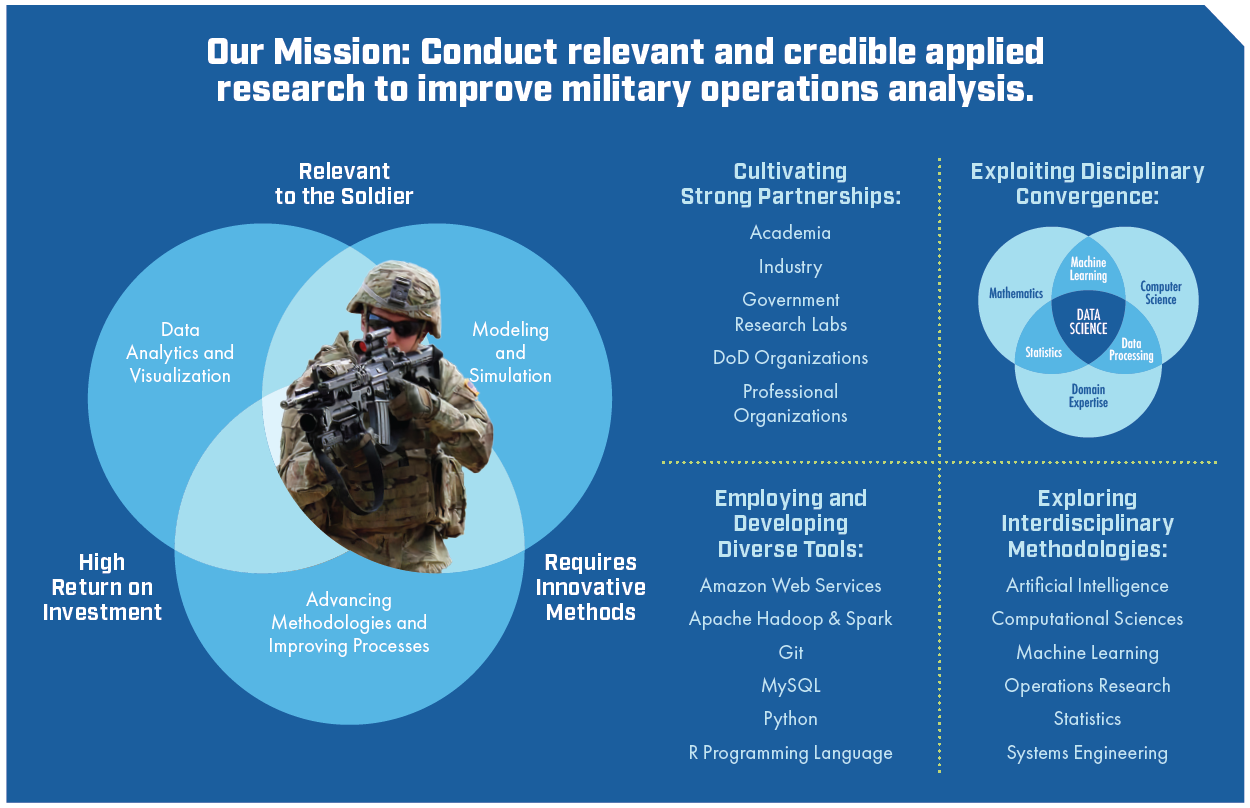
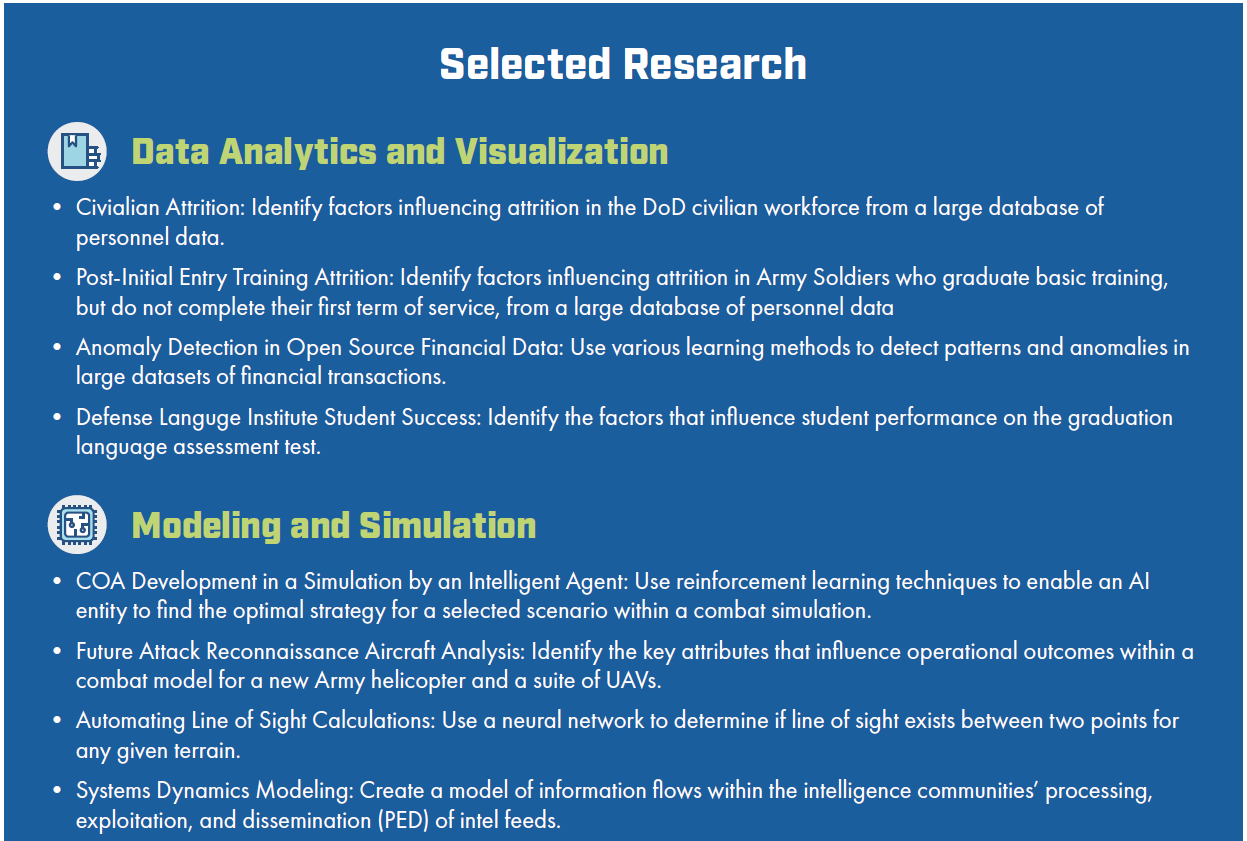
- Accomplish research in two major areas: (1) high-level computer simulations concepts and advanced technologies for modeling military operations focusing on system interoperability in distributed environments; and (2) practical, real-world military operations research problems of importance to the Army.
- Sustain a strong outreach program that maintains close ties between TRAC and various Army commands and agencies.
- Provide professional development opportunities for Army officers assigned to TRAC-Monterey from the FA49 community that enhance their skills, knowledge and experiences as both military officers and operations research analysts.
- Sponsor practical, academically and professionally enriching military oriented "experience tours," course projects and Masters Theses for officers from all branches of service attending the Naval Postgraduate School (NPS).
TRAC-Monterey's two major research thrusts, leading edge computer simulation research and current military operations research problems, ensure the Center remains relevant and closely linked with the Army.
World-class faculty and students from the Naval Postgraduate School (NPS) support the Center's research initiatives. TRAC-Monterey's research program offers NPS faculty a broad range of opportunities for studying meaningful, challenging applied problems that support NPS curricula and enhance professional development.
The Center's research program also supports students from all branches of military service with opportunities to investigate a wide range of interdisciplinary issues. TRAC's research program is particularly well suited to military officers who wish to apply many operations research, applied mathematics, engineering, and computer science concepts studied in the classroom to solving real-world military problems.
Organization and Facilities
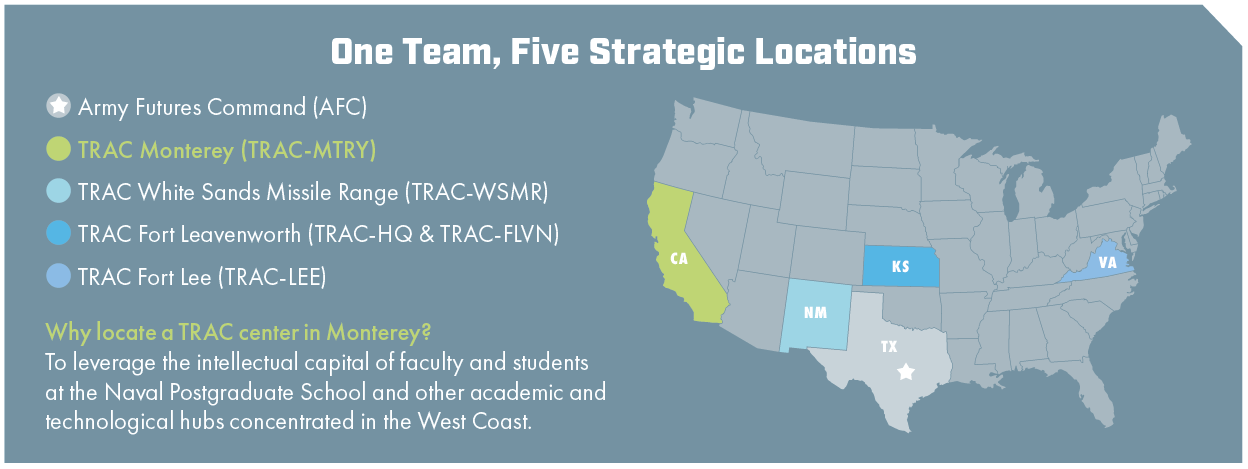
TRADOC Analysis Center (TRAC) Headquarters is located at Fort Leavenworth, Kansas. TRAC-Monterey is one of four analysis centers organized under TRAC Heaquarters. The other centers shown in the figure below are TRAC-Fort Leavenworth, Kansas, TRAC-White Sands Missile Range, New Mexico, and TRAC-Fort Lee, Virginia.
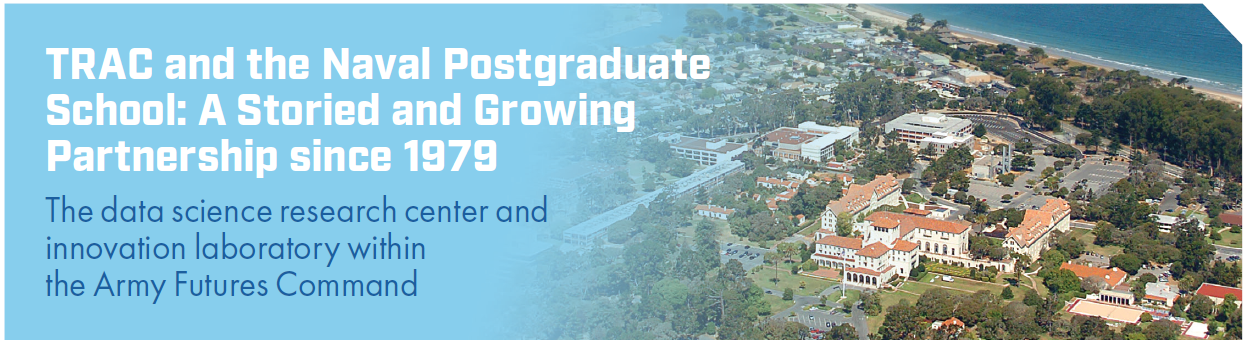
TRAC-Monterey is located on the grounds of the Naval Postgraduate School, Monterey, California. Facilities include offices for the director, analysts, administrative personnel, plus a conference room. There is also a combat simulation laboratory, contractor work areas, and a second briefing area.
Our Ethical Values
Ethics are standards by which one should act based on values. Values are core beliefs such as duty, honor, and integrity that motivate attitudes and actions. Not all values are ethical values (integrity is; happiness is not). Ethical values relate to what is right and wrong and thus take precedence over nonethical values when making ethical decisions. TRAC employees should carefully consider ethical values when making decisions as part of official duties. Primary ethical values include:
Honesty. Being truthful, straightforward, and candid are aspects of honesty.
Truthfulness is required. Deceptions are usually easily uncovered. Lies erode credibility and undermine public confidence. Untruths told for seemingly altruistic reasons (to prevent hurt feelings, to promote good will, etc.) are nonetheless resented by the recipients.
Straightforwardness adds frankness to truthfulness and is usually necessary to promote public confidence and to ensure effective, efficient conduct of operations. Truths presented in such a way as to lead recipients to confusion, misinterpretation, or inaccurate conclusions are not productive. Such indirect deceptions can promote ill-will and erode openness, especially when there is an expectation of frankness.
Candor is the forthright offering of unrequested information. It is necessary according to the gravity of the situation and the nature of the relationships. Candor is required when a reasonable person would feel betrayed if the information were withheld. In some circumstances, silence is dishonest; yet in other circumstances, disclosing information would be wrong and perhaps unlawful.
Integrity. Being faithful to one’s convictions is part of integrity. Following principles, acting with honor, maintaining independent judgment, and performing duties with impartiality help to maintain integrity and avoid conflicts of interest and hypocrisy.
Loyalty. Fidelity, faithfulness, allegiance, and devotion are all synonyms for loyalty. Loyalty is the bond that holds the nation and the Federal Government together and the balm against dissension and conflict. It is not blind obedience or unquestioning acceptance of the status quo. Loyalty requires careful balancing among various interests, values, and institutions in the interest of harmony and cohesion.
Accountability. TRAC employees are required to accept responsibility for their decisions and the resulting consequences. This includes avoiding even the appearance of impropriety. Accountability promotes careful, well-thought-out decisionmaking and limits thoughtless action.
Fairness. Open-mindedness and impartiality are important aspects of fairness. TRAC employees must be committed to justice in the performance of their official duties. Decisions must not be arbitrary, capricious, or biased. Individuals must be treated equally and with tolerance.
Caring. Compassion is an essential element of good government. Courtesy and kindness, both to those we serve and to those we work with, help to ensure individuals are not treated solely as a means to an end. Caring for others is the counterbalance against the temptation to pursue the mission at any cost.
Respect. To treat people with dignity, to honor privacy, and to allow self-determination are critical in a government of diverse people. Lack of respect leads to a breakdown of loyalty and honesty within a government and brings chaos to the international community.
Promisekeeping. No government can function for long if its commitments are not kept. TRAC employees are obligated to keep their promises in order to promote trust and cooperation. Because of the importance of promisekeeping, TRAC employees must only make commitments within their authority.
|